
Archive note: This retrospective market briefing was added to the BNO Trading archive in August 2026. Its sources are limited to information available by the assigned article date.
A buyer reading that global cocoa has swung from a heavy deficit to a surplus might assume beans, powder and liquor are now easier to buy and cheaper to land. That assumption does not survive a purchase order. A balance sheet describes a finished season in aggregate, using estimates. It says nothing about the grade, packaging, port or date you actually need.
The latest published position, in the International Cocoa Organization’s May 2026 Quarterly Bulletin of Cocoa Statistics, is better than the season before. It is also an estimate ICCO has revised once already and may revise again.
What the Updated Cocoa Balance Means
The vocabulary is worth translating. Production is the beans harvested worldwide in a crop year. Grindings are the beans processed into liquor, butter and powder, the closest published proxy for demand. Production above grindings gives a surplus, below it a deficit. Stocks are what remains in store at season end, and the stocks-to-grindings ratio states them as a share of a year’s processing: the cushion in the system.
According to that bulletin, 2024/25 production reached 4.723 million tonnes, up 361,000 tonnes or 8.3% year on year, while grindings fell to 4.628 million tonnes, down 182,000 tonnes or 3.8%. The result is an estimated surplus of 48,000 tonnes, against a deficit of 492,000 tonnes in 2023/24, when production was 4.362 million tonnes and grindings 4.810 million tonnes. End-of-season stocks were 1.320 million tonnes, a stocks-to-grindings ratio of 28.5%.
Note the composition of that swing. Production rising 8.3% is a supply story; grindings falling 3.8% is a demand story. A surplus produced partly by processors buying less is a weaker signal than one from a bigger crop, because demand returns faster than trees grow.
The number is also provisional. The 48,000 tonnes is a downward revision from the 75,000 tonnes ICCO published in February 2026, and ICCO states figures may be revised again in later bulletins. A surplus that small is slight against the volumes involved, so a similar revision could reshape the season. It is the best current estimate of a finished crop year, not settled fact, and no 2025/26 balance has been published.
Cocoa Beans, Cocoa Powder and Cocoa Liquor Are Different Markets
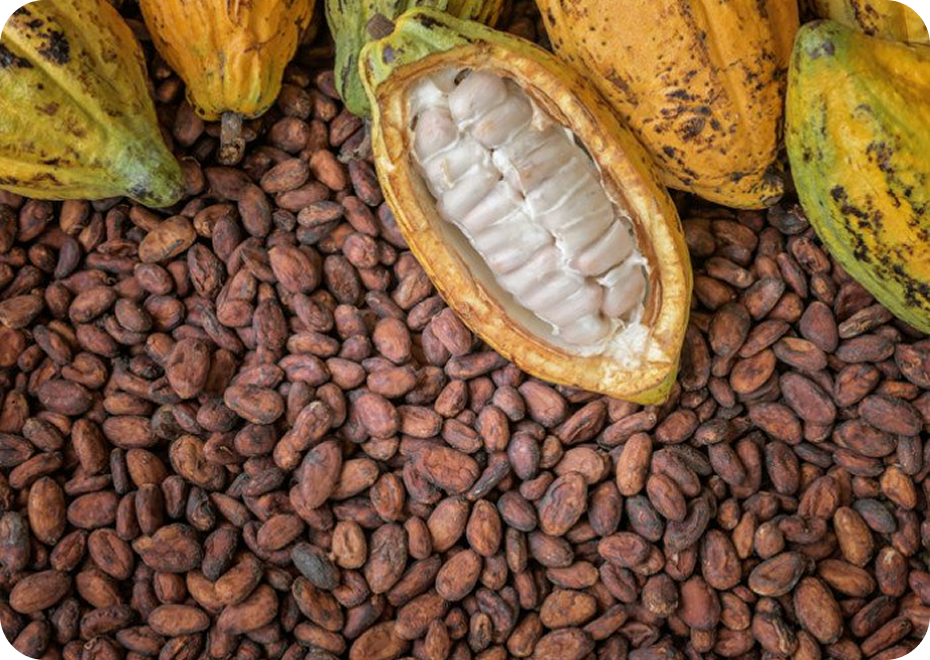
That balance is expressed in beans, and most buyers do not buy beans. Cocoa beans are an agricultural commodity: bagged, graded on physical criteria, bought mainly by processors and traders able to clean, roast and grind. Contracts turn on origin, crop year and physical quality.
Alkalized cocoa powder is a manufactured ingredient bought by bakeries, beverage producers and confectioners. Its specification is functional rather than agricultural: fat content, pH and alkalization level, colour, fineness, flavour and microbiological limits, with packaging, batch coding and shelf life in the same document.
Cocoa liquor sits between the two. It is ground bean mass in blocks or bulk liquid, and carries handling requirements the other forms do not: storage conditions, melting and tempering capability at the receiving plant, and delivery timing.
So a soft bean market does not automatically produce a soft powder market. Processing capacity, alkalization runs, packaging availability and butter-to-powder ratios sit in between, and each can bind alone.
Why Origin and Quality Still Matter
A surplus year does not make quality uniform. Fermentation determines much of the flavour a manufacturer tastes. Moisture affects storage life and mould risk. Bean size and count affect yield. Foreign matter, broken and flat beans, mould and insect damage reduce usable material. Beans dried near open fires can carry smoke taint that survives roasting.
Traceability and storage conditions decide whether the cargo you approved is the cargo you receive. Agree the specification and test methods in writing before committing: which parameters are graded, how each is measured, who samples and when, and what happens if a result falls outside tolerance. A specification with no agreed method of measurement is an argument waiting to happen.
Why Spot Price Is Not the Buyer’s Full Cost
A quoted price is one component of a landed cost. Between an origin warehouse and a UAE production line sit inland transport, processing and packaging, inspection, export documentation, ocean freight, marine insurance, customs duty and clearance, warehousing, and the financing cost of the working capital tied up.
Several of those lines track energy rather than cocoa fundamentals. The World Bank’s April 2026 Commodity Markets Outlook forecasts commodity prices up 16% in 2026 and energy up 24%, with Brent crude averaging $86 a barrel against $69 in 2025, and an escalation scenario at $115. Fertilizer is forecast up 31% and urea up 60%, which feeds into origin costs over time.
The International Energy Agency’s 22 June 2026 commentary documents the driver. Disruption to the Strait of Hormuz began on 28 February 2026, transits fell from roughly 20 million barrels a day to an average 2.7 million across March to May, and North Sea Dated peaked at an all-time high of $144 a barrel before the agency’s 400 million barrel release reached 2.5 million a day by May.
None of this changes what a bean is. It changes bunker costs, insurance, routing, lead times, and the gap between a screen price and an invoice. The wider basket has not moved in one direction either: FAO’s 5 June 2026 release put its Food Price Index at 130.8 points, down 0.2% and broadly stable.
Questions a Serious Cocoa Buyer Should Ask
- Product form. Beans, liquor or powder, and for powder the alkalization level.
- Origin. Country, growing region where available, and exporter of record.
- Crop year. Which harvest it comes from and how long it has been stored.
- Specification. The full parameter list in writing, with a test method per line.
- Sample availability. Whether a pre-shipment sample can be approved pre-loading.
- Certificate of analysis. Which laboratory issues it, against which methods.
- Packaging. Bag or block format, liner, unit weight, pallet configuration.
- Minimum order quantity. The real minimum for that form and origin today.
- Incoterm. Which rule, which edition, and where cost and risk transfer.
- Lead time. Time to loading and realistic transit, with routing stated.
- Inspection. Who inspects, where, and whether a third-party surveyor is used.
- Payment terms. The instrument used and documents required for release.
- Claim procedure. Notification window, evidence required, how disputes are resolved.
BNO Trading’s Cocoa Product Range
BNO Trading is a B2B sourcing and commodity-trading business in Dubai, connecting UAE and GCC buyers with suitable supply. Cocoa beans, alkalized cocoa powder and cocoa liquor are listed among our products, and our team can discuss specifications, grades, packaging and lead times against a stated requirement.
We publish no standing tonnages or minimum order quantities for cocoa. Availability, minimums and lead times shift with origin, crop year, processing capacity and shipping conditions, so they are confirmed per enquiry rather than quoted as fixed.
Planning a Cocoa Purchase From Here
The honest reading is narrow: one completed season, estimated, revised down once, with a surplus small enough that another revision could reshape it, and part of the gain coming from weaker grindings rather than a larger crop. Buyers who fix specifications, test methods, packaging and Incoterms in writing will absorb whatever the next bulletin says. More commentary appears in our news and insights archive.
If you are contracting cocoa for the coming period, our team can work through product forms, origins, grades, packaging, lead times and a quotation against your specification.
Request Current Cocoa Specifications and Availability
Sources and Further Reading
- May 2026 Quarterly Bulletin of Cocoa Statistics — International Cocoa Organization, 29 May 2026.
- Commodity Markets Outlook, April 2026 — World Bank, 28 April 2026.
- How global oil supplies have readjusted to help fill the huge gap left by the Strait of Hormuz shock — International Energy Agency, 22 June 2026.
- FAO Food Price Index broadly stable in May even as cereal quotations increase — Food and Agriculture Organization of the United Nations, 5 June 2026.

 English